
Physician practices could face very different Medicare payment changes in 2027, even within the same specialty. CMS’ proposed Physician Fee Schedule would lower the conversion factor for most clinicians while changing how Medicare values procedures and pays for certain visits performed on the same day as a procedure.
Practices need to look beyond the national averages when building their budgets. The financial impact will depend on the services their physicians provide, their Medicare volume and their payment locality.
Proposed Medicare payment reductions
CMS proposes a conversion factor of $32.8409 for clinicians who do not qualify as Advanced Alternative Payment Model participants, a 1.68% decrease from 2026. Qualifying participants would receive a conversion factor of $33.1693, down 1.19%. The expiration of Congress’ temporary 2.5% increase for 2026 accounts for much of the decline.
Wakely estimates an average reimbursement decline of approximately 2.2% for nonqualifying clinicians. However, its model excludes the proposed same-day E/M and global procedure reduction and proposed remote monitoring payment changes. Practices that provide those services could face additional reductions.
How specialties could be affected
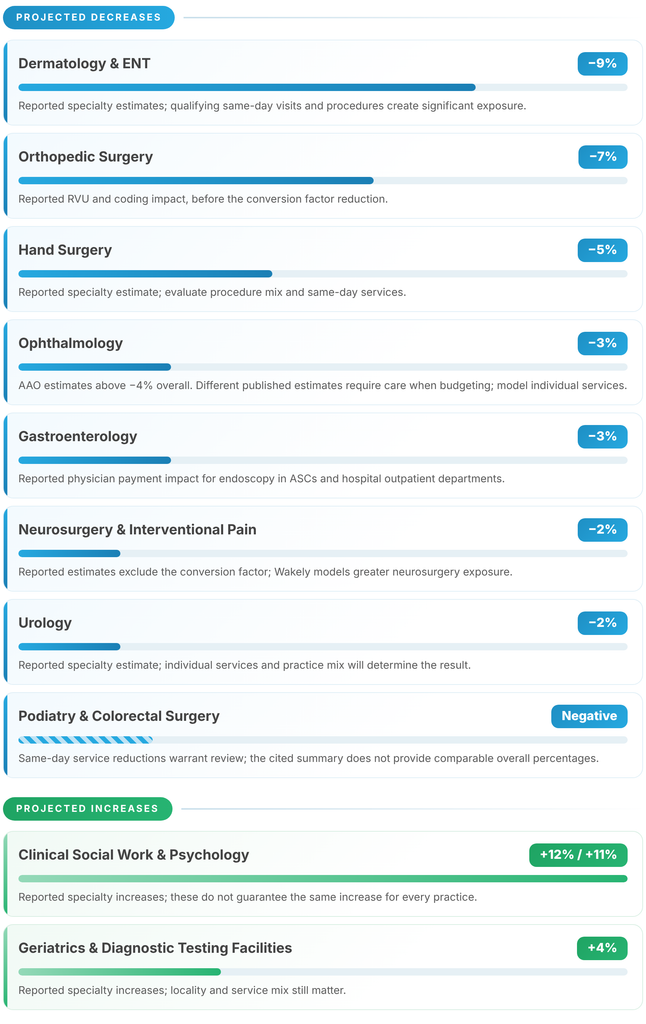
The estimates below come from analyses that use different methods and measure different parts of the proposal. Before using a percentage in a budget, confirm whether it includes the conversion factor reduction and which services it covers.
Same-day visits and procedures
CMS proposes paying the highest-valued qualifying service in full and paying other applicable same-day surgical procedures or E/M services at 50% when a separately identifiable office or outpatient E/M visit accompanies a procedure with a 0-, 10- or 90-day global period. The proposal addresses services furnished by the same physician or physicians in the same practice.
Practices that regularly evaluate and treat patients during the same visit should review their most common service combinations. Dermatology, ENT and podiatry face particular pressure from this proposal. Revenue cycle teams should identify the affected code pairs and calculate the reduction for each eligible combination.
Physicians must continue documenting the significant, separately identifiable work that supports an E/M service. Any scheduling changes should reflect the patient’s clinical needs, and coding teams should review whether the record supports each service billed.
Orthopedic organizations should examine total joint replacement closely. The American Association of Hip and Knee Surgeons identifies proposed 20% RVU reductions for total hip replacement, CPT 27130, and total knee replacement, CPT 27447. Those code-level changes should inform the practice’s model; adding them to a specialty average would double-count effects already reflected in that average.
Ophthalmology practices should review cataract volume alongside office visits and diagnostic services. EyeWorld reports proposed reimbursement of $444.34 for routine cataract surgery, CPT 66984, approximately 4% below 2026. That professional payment estimate does not describe the ASC facility fee, and local payment adjustments will affect actual reimbursement.
Pain, spine and GI organizations should budget separately for professional and facility revenue. The Physician Fee Schedule governs physician payment, while CMS sets ASC facility payment through a separate rule. GI societies have also raised concerns about proposed facility reductions for common endoscopy services. [8]
Some behavioral health and primary care-oriented services could receive higher payments. Practices should identify which services account for those increases and check their own volume before projecting additional collections.
Primary care organizations should also follow CMS’ proposed replacement of G2211 with percentage-based E/M complexity modifiers. If CMS finalizes that change, affected practices will need to update charge capture and billing workflows to reflect the final eligibility and reporting requirements.
Preparing your practice for 2027
Start with 12 months of claims and reprice the same service mix under the proposed rates. Analyze results by specialty, provider, location, place of service and qualifying APM status, then account for applicable same-day payment policies. Review Medicare Advantage and commercial contracts individually to determine whether their terms incorporate Medicare fee schedule changes.
Use that forecast to set priorities for coding education, authorization workflows, charge capture and underpayment monitoring. Track net collection rate, denial rates, days in A/R and collections against expected allowed amounts so leaders can distinguish a payment policy reduction from a preventable revenue cycle loss. After implementation, research payment variances through resolution and confirm that the payer ultimately pays the correct amount.
Assembly Health’s approach to RCM starts with the details of each specialty, from the services physicians provide to the payment rules that affect collections. Contact our team to discuss how the proposed changes could affect your practice and where stronger billing, follow-up and payment review can help protect revenue.
These policies remain proposed as of October 20, 2026. CMS may revise them in the final rule, and subsequent legislation could change the payment outlook.
References
1. CMS. CY 2027 Medicare Physician Fee Schedule Proposed Rule fact sheet, July 14, 2026.
4. Becker’s ASC Review. Medicare’s proposed 2027 pay cuts, by specialty, October 14, 2026.
5. American Academy of Ophthalmology. Medicare Physician Fee Schedule: 2027 highlights.
8. ASGE, ACG and AGA. Joint comments on the CY 2027 OPPS/ASC proposed rule, August 28, 2026.